Award Winning Running Coach, Fitness and Health Professional
  • Home
  • Contact
  • Online Training Plans
  • Group Training session
  • 1-2-1 Running sessions
  • Strength and conditioning
  • Inspirational Speaking
  • Gym Hire
  • Injury Rehab
  • About
  • Blog
  • Articles and videos
  • Health declaration form

"The plan is to die young but as late as possible"

2/11/2017

0 Comments

 
​Throughout the 20th century, global lifespan doubled, a trend that continued into the 21st century. If you were lucky enough to be born in 2007 or later you have a 50% chance of seeing your 100th birthday. If you are around 50 years old just now you can reasonably expect to reach 83. I happen to be in between these two age groups but I'll tell you one thing for sure, I have no intention to kick the bucket any time before hitting a full century and then some. Although there are no guarantees, here’s a few helpful hints and tips on how I plan to do it. 
 
I heard of this magic little pill. It improves strength, endurance, muscle quality and function. It reduces risk of heart disease, cancer, diabetes, anxiety and stress. It even helps with concentration, self-esteem and weight management. The pill comes in different forms, sometimes it's easy to take and sometimes it's hard to swallow. Whatever form it comes in, it always makes me feel satisfied, relaxed and happy. That's why I make it a priority to take this magic little pill 6 or 7 days a week. 
 
Exercise being good for us is nothing new. In fact there is documented evidence dating back to 1949 when Jerry Morris studied London’s double decker bus staff. He noticed that the drivers, who were static most of the day, had a much higher incidence of heart disease than the conductors who were walking up and down stairs numerous times a day. He extended his study to the postal service and noticed the same pattern. Employees sitting behind counters had a much higher incidence of heart disease than those delivering post on foot. His study was published in The British Medical Journal in 1958. 

Your body is constantly adapting. Like an organic garden hosting billions of bacteria and a river of red blood cells generating millions of new cells per second. Your body strives to reach a balance known as homeostasis. As we progress through life we are always either growing or decaying. For the most part, you have the choice whether to "catabolise"- breakdown molecules or "anabolise" - manufacture new cells. So how do we maximise growth and minimalise decay? 
 
Firstly, take your medicine as prescribed above. Simply moving more and sitting less can have a profound influence on reducing your risk of early death. In 2009, a study of over 17,000 people showed that no matter how active you are, the more you sit down, the more you increase your risk of chronic disease. So even if you are a regular gym bunny, but you sit in an office all day, make sure you take plenty of active breaks. Every 55 minutes go for a 5 minute walk. 
 
Recovery is where it all happens. Exercise of all forms produces a stress response from the body. Applying appropriate levels of stress over time with enough recovery, will encourage the body to adapt and you become stronger and fitter. Without recovery, you simply drain your battery.
 
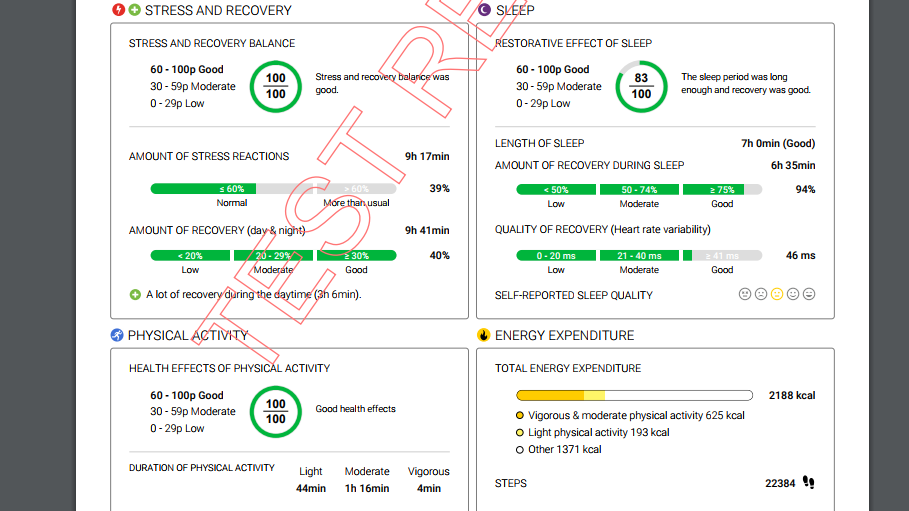
Doctors these days report that fatigue is one of the most common complaints and is often characterised by lack of motivation, lethargy and sleepiness. Sound familiar? Wearable technology is fast becoming the next global fitness trend. They can measure a whole host of markers including daily activity, heart rate and sleep. Wearable technology by itself won't drive behaviour change but I find it can be useful to draw attention to key areas of life such as sleep, and seeing improvements can be rewarding and often helps to promote behaviour change. I use a device called Firstbeat which measures sleep quantity and quality as well as exercise and stress, by measuring heart rate variability (beat to beat variations in heart rate) as well as basic heart rate and movement. (More on heart rate variability another time.)  There's a whole host of evidence linking poor sleep to a higher incidence of chronic disease and premature death. 
 
Research has shown that Blue light from television and mobile devices suppresses melatonin production by as much as 22% which could negatively affect sleep. We also know that alcohol inhibits sleep quality so phones off 30 minutes before bedtime and cut down on the booze. After all bedrooms are for more important things than watching television (ahem).
 
So as we progress through life and through the 21st century, you have the decision to make. Do you want to merely improve your lifespan or do you want to improve your "health- span?" I want to improve my enjoyment span. So whatever that entails is the most important thing...Being Happy.

Picture
0 Comments


Leave a Reply.

make the most of your precious training time!


Address


Glasgow
​G43 2AW

Telephone

07974201938

Email

[email protected]
​[email protected]
  • Home
  • Contact
  • Online Training Plans
  • Group Training session
  • 1-2-1 Running sessions
  • Strength and conditioning
  • Inspirational Speaking
  • Gym Hire
  • Injury Rehab
  • About
  • Blog
  • Articles and videos
  • Health declaration form